
How a landmark Maryland bill could reshape civil liability — and what LGBTQ+ residents and families need to know
For many LGBTQ+ Marylanders, the scars left by conversion therapy are not just emotional — they are legal injuries that have gone without remedy for far too long. A bill currently moving through the Maryland General Assembly may change that. Senate Bill 950, sponsored by Sen. Cheryl Kagan (D-Montgomery County), proposes to dramatically strengthen the state's existing ban on conversion therapy by giving survivors the power to file a health care malpractice action against any practitioner who subjected them to the discredited and harmful practice. The companion House Bill 1209 is sponsored by Del. Bonnie Cullison (D-Montgomery County). At the Law Offices of Thomas Stahl, we closely track legislation that affects the rights and well-being of Maryland and D.C. families. This bill matters — and here is what you need to know.
What Is Conversion Therapy?
Conversion therapy — also known as reparative therapy, sexual orientation change efforts (SOCE), or gender identity change efforts (GICE) — refers to any intervention that attempts to change a person's sexual orientation or gender identity. Practitioners have historically employed a disturbing range of techniques, from talk therapy and behavioral conditioning to, in earlier decades, aversion therapy involving electric shocks and chemical-induced nausea.
The history of conversion therapy in the United States is a troubling one. The practice gained traction after 1952, when the American Psychiatric Association (APA) classified homosexuality as a mental disorder in the first edition of the Diagnostic and Statistical Manual of Mental Disorders (DSM-I). This medicalization of LGBTQ+ identity provided a false scientific veneer for efforts to "cure" gay and transgender individuals. It also coincided with the so-called Lavender Scare of the 1950s and '60s, a period of intense government-driven persecution of LGBTQ+ people who were falsely characterized as security threats to the nation.
A pivotal shift came in 1973, when the APA removed homosexuality from the DSM after sustained advocacy from LGBTQ+ activists and researchers who challenged the junk science underlying its pathologization. Despite this, conversion therapy practitioners continued operating, often under the banner of religious or "pastoral" care. In 1998, the American Psychiatric Association formally opposed conversion therapy, and major medical organizations have followed suit ever since. Nevertheless, the practice persisted — particularly targeting minors whose parents sought to change their sexual orientation or gender identity.
Why Conversion Therapy Is Harmful: What Medical Experts Say
Today, the scientific and medical consensus on conversion therapy is unambiguous: it does not work, and it causes serious harm. Every major medical and mental health organization in the United States has condemned it.
The American Psychological Association (APA) conducted a landmark systematic review in 2009 and concluded that sexual orientation change efforts are unlikely to produce the intended change and carry real risks of harm. The APA found evidence linking conversion therapy to depression, anxiety, and self-destructive behavior. (APA Resolution on Sexual Orientation Change Efforts)
The American Psychiatric Association has opposed conversion therapy since 1998 and reaffirmed in 2020 that efforts to change a person's sexual orientation or gender expression "have been shown to be harmful and potentially deadly."
The American Medical Association (AMA) has documented that conversion therapy rests on the false and unscientific premise that LGBTQ+ identities are disorders requiring treatment. The AMA's issue brief notes that practitioners have used techniques including aversive conditioning — such as electric shocks and food deprivation — to attempt to change sexual orientation. The AMA opposes all such practices. (AMA Issue Brief on Conversion Therapy)
The Substance Abuse and Mental Health Services Administration (SAMHSA) has stated that conversion therapy is coercive, can be harmful, and is not appropriate for minors.
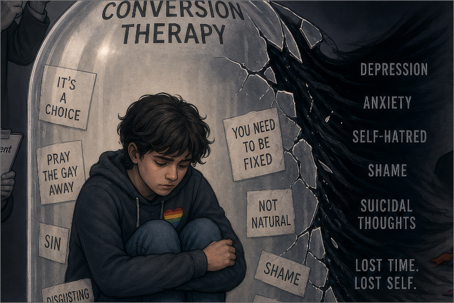
Research consistently links exposure to conversion therapy with increased rates of depression, anxiety, suicidal ideation, suicide attempts, social isolation, substance abuse, homelessness, and lowered self-worth. Studies show that LGBTQ+ youth who undergo conversion therapy are significantly more likely to attempt suicide than those who do not. These are not minor side effects — they are life-altering and, in too many cases, fatal consequences.
Survivors of conversion therapy often report that the harm is not immediately obvious. The practice instills shame and self-loathing, silences survivors, and conditions them to believe their authentic identity is a flaw to be fixed — effects that can take years or decades to fully surface and process.
Maryland's Existing Ban — and Why It Needs Strengthening
In 2018, Maryland became the 11th state in the nation to ban conversion therapy on minors, thanks to legislation championed by then-Sen. Rich Madaleno Jr. — now the Chief Administration Officer of Montgomery County. That law prohibits licensed mental health practitioners from performing conversion therapy on patients under 18 and authorized civil complaints under the existing three-year statute of limitations.
However, significant gaps remain. Three years is often not enough time for survivors to come to terms with what was done to them. Conversion therapy creates shame, silence, and trauma that can take years to surface. Many survivors do not connect their adult mental health struggles — depression, anxiety, self-harm, fractured relationships — to conversion therapy they underwent as a child until long after the legal window has closed. By the time they are ready to seek legal recourse, they may find the courthouse doors shut.
What Maryland Senate Bill 950 Would Do
Senate Bill 950 proposes critical updates to Maryland's conversion therapy prohibition. Under the bill:
For survivors who were minors: A civil malpractice action could be filed at any time — effectively eliminating the statute of limitations for minors subjected to conversion therapy. Under current Maryland law, the statute of limitations for a minor's personal injury claim is generally tolled until the minor reaches age 18, at which point a three-year window opens. SB 950 would go much further, recognizing that the trauma of conversion therapy experienced in childhood may not be fully understood or processed until well into adulthood.
For adult survivors: The bill would allow a civil action to be filed within 20 years of when the conversion therapy occurred — a substantial extension from the current three-year window.
For families and practitioners: The bill would allow civil malpractice actions against mental health practitioners, child care practitioners, and other health care providers who conduct conversion therapy. This creates direct financial accountability for practitioners who violate Maryland's ban.
"Conversion therapy infuriates me," Sen. Kagan has stated. "It says to someone that you're wrong, you're a bad person, you're flawed. We need to fix you. It's time to update and strengthen that law."
Sen. Kagan noted that survivors may not recognize the harm caused by conversion therapy until years later, which is precisely why the extended statute of limitations is critical. The bill advances the principle that victims of licensed professionals who violate a clear legal prohibition should not be barred from civil relief simply because the harm was hidden — by shame, by trauma, or by time.
Why This Matters to Maryland's LGBTQ+ Community
For LGBTQ+ Marylanders, Senate Bill 950 is more than a legal procedural change — it is a statement that this state stands with its LGBTQ+ residents even as the federal political climate grows increasingly hostile. Sen. Kagan has been direct: "This [federal] administration has it out for the LGBTQ community. I don't know what bee is in their bonnet, but in Maryland, we respect the community. We are inclusive."
That context is not incidental. Multiple federal actions in 2025 and 2026 have rolled back LGBTQ+ protections at the national level, making state-level protections all the more critical. Maryland has long been a leader on LGBTQ+ equality, and SB 950 is consistent with that history.
Practically speaking, the bill matters because conversion therapy has not disappeared. While overt practices have been driven underground in states with bans, survivors continue to come forward — many of them now adults who were subjected to conversion therapy in religious or clinical settings as children decades ago. Without a meaningful legal remedy, those survivors have had no recourse. SB 950 would change that.
Del. Bonnie Cullison, a founding member of the Maryland Legislative LGBTQ+ Caucus and sponsor of companion House Bill 1209, framed SB 950 as a necessary strengthening of existing law in the face of efforts elsewhere to revive and expand conversion therapy. "It's decency, it's dignity, and it's humanity," said caucus chair Del. Kris Fair (D-Frederick County) of the caucus's 2026 priorities.
Legal Accountability: Civil Malpractice and the Path Forward
From a legal standpoint, SB 950 is a significant development in medical malpractice law as it applies to LGBTQ+ rights. By framing conversion therapy as a health care malpractice issue — rather than just an administrative or licensing violation — the bill creates a private right of action for survivors. This means that injured individuals, not just regulators, can hold practitioners accountable in court.
The extension of the statute of limitations for minors to an unlimited period reflects a growing legal understanding that childhood trauma often does not manifest in its full form until adulthood. Maryland courts have recognized similar principles in other areas of abuse litigation, and SB 950 applies that logic to conversion therapy.
If you or a family member believe you have been subjected to conversion therapy by a licensed provider in Maryland, the civil legal landscape is changing. Documentation of the therapy, records of mental health treatment, and contemporaneous accounts are all potentially valuable evidence in any future legal action.
The Law Offices of Thomas Stahl Can Help You on Family Law and Estate Planning Matters
At the Law Offices of Thomas Stahl, we are committed to serving Maryland and Washington, D.C. families with compassion, integrity, and a deep knowledge of evolving state law. While our practice focuses on family law and estate planning, we understand that legal developments like SB 950 intersect directly with the lives of the families we serve.
Whether you have questions about family law matters involving LGBTQ+ issues, or estate planning for same-sex couples and families, our office is here to help. We serve clients across Maryland and Washington, D.C. and stay current on the legislative changes that affect your rights and your family's future.
Contact the Law Offices of Thomas Stahl today to speak with an attorney about your legal needs. Call 443-300-9208 today to schedule a consultation.
Disclaimer: This blog post is provided for general informational purposes only and does not constitute legal advice. Reading this article does not create an attorney-client relationship. Laws and pending legislation are subject to change. If you have specific legal questions, please consult a qualified Maryland attorney.