
Every landmark legal victory begins somewhere humble. For the case that struck down one of the most discriminatory federal statutes in modern American history, it began on a Friday night in 1963, at a restaurant in Greenwich Village, when a dark-haired woman named Thea Spyer turned around and told a stranger named Edie Windsor, "Now it is" — in answer to the question of whether her dance card was full.
What followed was one of the great American love stories: 44 years of partnership, devotion, dancing, and determination. It was also the foundation of United States v. Windsor, the 2013 Supreme Court decision that struck down Section 3 of the Defense of Marriage Act (DOMA) and forever changed the legal landscape for LGBTQ+ Americans. As we mark Pride Month this June, it is worth pausing to understand not just what the Court decided — but why it mattered, who made it happen, and why we must remain vigilant about protecting what was won.
The Law That Started It All: DOMA
In 1996, as a small number of states began debating whether to recognize same-sex marriages, Congress moved to preempt what many feared would be a domino effect of marriage equality spreading across the country. The result was the Defense of Marriage Act, signed into law by President Bill Clinton on September 21, 1996.
Section 3 of DOMA was its most consequential provision. It amended the federal Dictionary Act — the law that defines terms used across all federal statutes — to declare that, for all federal purposes, "marriage" meant only "a legal union between one man and one woman as husband and wife," and that "spouse" referred only to a person of the opposite sex. With that single provision, the federal government effectively erected a two-tiered system of marriage in America. As SCOTUSblog documented in its coverage of the case, DOMA applied to more than 1,000 federal statutes and all federal regulations — from tax law to Social Security survivor benefits to immigration to military spousal benefits. Legally married same-sex couples were locked out of every single one.
According to the Constitutional Accountability Center, the law's majority opinion later found that DOMA's "principal purpose" was to "impose inequality" — that it was not an incidental byproduct of the law, but its very essence. But in 1996, DOMA passed with overwhelming bipartisan support, 342–67 in the House and 85–14 in the Senate.
Edie and Thea: 44 Years and a $363,053 Tax Bill
When Edie Windsor met Thea Spyer, she could not have imagined that half a century later, a Supreme Court case bearing her name would make her a national hero. What she knew was that she had found the love of her life.
The two women were together for decades before they could legally marry. In 1967, Thea proposed — offering Edie a diamond brooch instead of a ring so that her colleagues at IBM would not ask awkward questions about an engagement. They waited 40 more years. In 2007, with Thea suffering from advanced multiple sclerosis and able to move only one finger, they traveled to Toronto, Canada, and were married. New York State recognized their marriage as valid.
Thea Spyer died on February 28, 2009. She left her entire estate to the woman she had loved for more than four decades. Edie Windsor, then 80 years old and recovering from a heart attack she suffered in the hospital a month after Thea's death, applied for the federal estate tax exemption available to surviving spouses. The IRS denied her claim. Because of DOMA, the federal government did not recognize their marriage. Windsor was forced to pay $363,053 in estate taxes — a bill she would not have owed if her spouse had been a man.
As CNN reported in its coverage of the case, Windsor recalled the moment clearly: the realization that the country's laws had declared her marriage, her life, her love — less worthy. "We were mildly affluent and extremely happy," she told reporters. "We were like most couples." Except, in the eyes of the federal government, they were not.
On November 9, 2010, at age 81, Edie Windsor filed suit in the Southern District of New York, represented by attorney Roberta Kaplan and the ACLU, seeking a refund and challenging the constitutionality of DOMA. It was, as Kaplan later said, a case for the history books. Windsor would later reflect: "DOMA violated the fundamentally American principles of fairness and equality."
(Watch Edie Windsor reflect on her life with Thea Spyer in TIME Magazine's video portrait on YouTube: youtube.com/watch?v=ZdAErLK4ti8)
The Case Moves to the Supreme Court
Windsor's case wound its way through the courts with remarkable speed, given the weight of its constitutional stakes. District Judge Barbara S. Jones ruled DOMA unconstitutional in September 2011. The Second Circuit Court of Appeals affirmed that ruling on October 18, 2012, applying heightened scrutiny to classifications based on sexual orientation — a novel legal standard that would prove significant.
Meanwhile, in a remarkable turn, the Obama Administration announced it would no longer defend DOMA in court, with Attorney General Eric Holder declaring in February 2011 that the law could not survive heightened scrutiny. House Speaker John Boehner then directed the Bipartisan Legal Advisory Group (BLAG) of the House of Representatives to step in and defend the law.
The Supreme Court granted certiorari on December 7, 2012. Oral arguments were heard on March 27, 2013. As SCOTUSblog's Lyle Denniston wrote in his argument recap, Justice Anthony Kennedy appeared to be the pivotal vote, and all eyes were on whether he would ground the ruling in states' rights, equal protection, or some novel combination of both.
June 26, 2013: The Decision
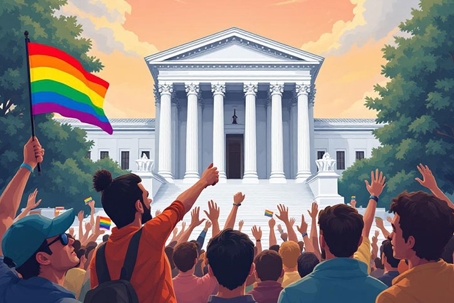
On a warm Wednesday morning in Washington, crowds of activists gathered on the marble steps of the Supreme Court. Inside, the justices were prepared to announce one of the most consequential rulings in the Court's history.
The decision in United States v. Windsor came down 5–4. Writing for the majority — joined by Justices Ginsburg, Breyer, Sotomayor, and Kagan — Justice Anthony Kennedy struck down Section 3 of DOMA as unconstitutional under the Fifth Amendment's guarantee of equal liberty. As the New York Civil Liberties Union summarized in its case coverage, the majority held that the federal government cannot discriminate against married same-sex couples for purposes of determining federal benefits and protections.
Kennedy's opinion drew on both federalism and equal protection principles. The Court found that states have long had the authority to define and regulate marriage — and that DOMA improperly displaced that authority, creating "two contradictory marriage regimes within the same state." More pointedly, as Justice Kennedy wrote, DOMA forced same-sex couples to "live as married for the purpose of state law but unmarried for the purpose of federal law," destabilizing their relationships and humiliating their families.
The majority opinion did not mince words about DOMA's purpose and effect. The law, it found, was "directed to a class of persons that the laws of New York and 11 other states have sought to protect" — and it sought not to protect anyone, but to demean and stigmatize. As Kennedy wrote: "DOMA instructs all federal officials, and indeed all persons with whom same-sex couples interact, including their own children, that their marriage is less worthy than the marriages of others. The federal statute is invalid, for no legitimate purpose overcomes the purpose and effect to disparage and to injure those whom the State, by its marriage laws, sought to protect."
The four dissenters — Chief Justice Roberts and Justices Scalia, Thomas, and Alito — challenged the Court's jurisdiction and the merits of the ruling. Justice Scalia, in a notably sharp dissent, argued that the majority had overstepped its constitutional authority.
Outside, when news of the decision trickled out, CBS News reported that activists erupted in cheers and chants. The crowd on the steps broke into a spontaneous rendition of "America the Beautiful." Rainbow flags were waving. "DOMA is dead," they chanted. One of those who cheered loudest was an 83-year-old woman who had waited more than four decades to be recognized as a wife — and who had spent the last three years fighting for every couple who came after her.
Edie Windsor's attorney, Roberta Kaplan, declared it "truly a day for the history books, one that will be marked by future generations as a giant step forward along our nation's continuing path towards equality."
Washington, D.C.'s own Congresswoman Eleanor Holmes Norton, a Georgetown University law professor and member of the Supreme Court bar, stated that the ruling "will give thousands of married same-sex couples in nine states and the District of Columbia access to almost 1,000 valuable federal benefits that they have been denied."
Why Windsor Matters — And Why the Fight Is Not Over
Windsor did not resolve every question. The ruling left to another day whether states could continue to ban same-sex marriages altogether. That question was answered two years later, in Obergefell v. Hodges (2015), which held that the Constitution requires all states to license and recognize same-sex marriages. Together, Windsor and Obergefell form the twin pillars of marriage equality in America.
But those pillars are under strain.
In his concurring opinion in Dobbs v. Jackson Women's Health Organization (2022) — the case that overturned Roe v. Wade — Justice Clarence Thomas explicitly called on the Court to "reconsider" Obergefell and other substantive due process precedents. Justice Samuel Alito has separately expressed concerns about the ruling. As The Hill reported in June 2025, on the 10th anniversary of Obergefell, Republican lawmakers in at least six states have issued formal calls for the Supreme Court to overturn the decision. Idaho's GOP-dominated House passed a nonbinding resolution calling Obergefell"an illegitimate overreach." A case brought by Kim Davis — the Kentucky county clerk who refused to issue marriage licenses to same-sex couples — has been petitioned to the Court in a way that could, if accepted, give Thomas and other conservative justices a vehicle to revisit marriage equality directly, as Minnesota Lawyer reported in September 2025.
Jim Obergefell — the plaintiff whose name graces the 2015 ruling — has spoken openly about his fears. As NBC News reported, he has drawn a direct parallel to the fall of Roe v. Wade: "For 49 years, people grew up with that right, and then with the proverbial stroke of a pen on that decision, that right was taken away. We have to learn from that."
Public support for same-sex marriage has grown: Gallup polling shows 68% of Americans now believe it should be legal. But the gap between parties has never been wider, with support among Republicans having dropped 14 points since 2022. In a political environment where courts can move faster than public opinion, that polling comfort offers only partial reassurance.
Pride Month and the Weight of History
June is Pride Month — a time that began not as a celebration, but as a protest. The first Pride marches in 1969 and 1970 were acts of defiance by people who had nothing to lose because the law offered them nothing to protect. Edie Windsor marched in the New York City Pride Parade every year, for years, carrying a giant rainbow flag. In 2013, she wrote that she danced her way down the street for the entire route.
Edie Windsor passed away on September 12, 2017, at the age of 88. In 2022, the New York City Council designated the corner of Fifth Avenue and Washington Square North — where she and Thea had lived for more than 40 years — as "Edie Windsor and Thea Spyer Way."
Her last public words on the subject remain the best summation of why this history matters and why we cannot be complacent: "Because of today's Supreme Court ruling, every child born today will be able to grow up in a world without DOMA — a world where the federal government won't discriminate against their marriages no matter who they are."
The work she did, the love she bore witness to, the tax bill she refused to simply pay and forget — it was not just for herself, or even for Thea. It was for every family that came after.
The Law Offices of Thomas Stahl: Proud to Serve Our Community
The Law Offices of Thomas Stahl proudly celebrates the legacy of United States v. Windsor and stands in full support of the LGBTQ+ community throughout Pride Month and every month. Based in Columbia, Maryland, our firm is honored to serve residents across Maryland and Washington, D.C. in a broad range of family law and estate planning matters — including marriage, divorce, custody, wills, trusts, powers of attorney, and the full range of issues that arise when families need legal guidance they can trust.
The rights won in courts like the Supreme Court only have real meaning when they are protected, planned for, and honored in your day-to-day legal life. Whether you are newly married, planning your estate, or navigating a difficult family transition, the Law Offices of Thomas Stahl is here to help you protect what matters most.
Contact us today to schedule a consultation. Your family's future deserves a firm that sees you, respects you, and fights for you.
Disclaimer: This article is intended for general informational and educational purposes only and does not constitute legal advice; readers should consult a qualified attorney regarding their specific legal circumstances.